
Garfield County Arrest Report Archive
The GCSO Activity Reports archive serves as the county's official blotter. It collects narrative summaries of criminal reports and arrests handled by the Garfield County Sheriff's Office. Those summaries are organized by date or date range. Single-day reports sit alongside bundles spanning many days. Recent examples include July weekends and one long stretch running July 30 through August 11. That mix makes the archive handy once the newest-booking view rolls forward. An older arrest may have already dropped off.
Do not expect a continuous 72-hour feed here. A report describes an event, and it can stay listed after custody ends. Municipal arrests are not guaranteed either. Rifle, Glenwood Springs, and Carbondale police keep their own incident reports. That authority holds even when a person is booked into the county detention facility. Think of the two tools as complements. The jail PDF answers who is in custody right now. The activity archive explains selected sheriff cases over time.
The official archive screen displays its date and range pattern. Open the Garfield County activity-report source before choosing a report.
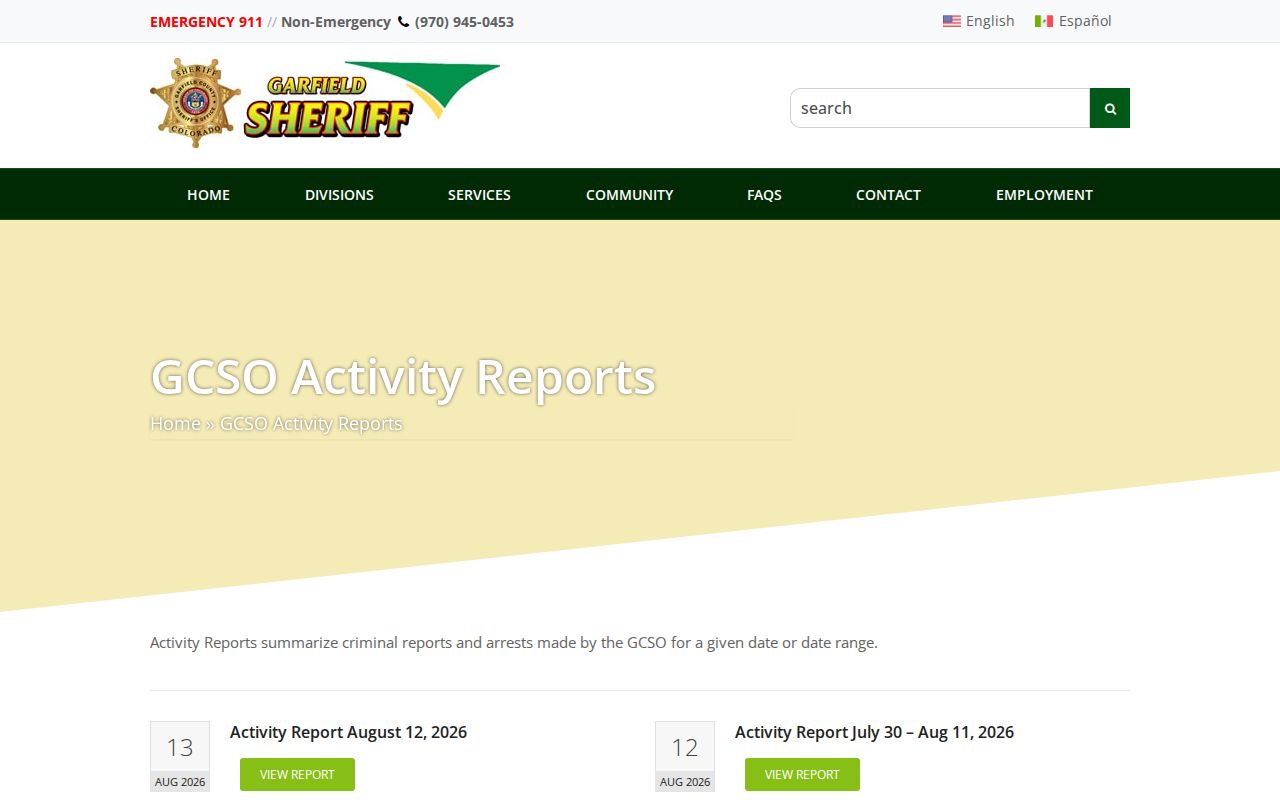
The county's multi-day report index mixes individual dates with bundled ranges.
Read Garfield County Arrest Reports
Start from the event date, not the posting date. Each archive title may cover one day or a longer span. Once opened, the landing page links the related PDF when one exists. A range title can hold several arrest events and bridge weekends or gaps, so read the whole report before concluding an incident is missing.
- Open the GCSO Activity Reports archive and identify the date or range that contains the event.
- Open the report page, then read the linked PDF and record the case number, case date, and agency context.
- Compare the arrested person's name and date of birth where shown. Do not rely on a name match alone.
- Use the current-inmate PDF when the question is present custody, since the activity report cannot answer it.
- Request the missing or older report from GCSO Records when the archive does not carry the needed period.
The Garfield County 24 Hour Arrests page tracks the newest visible bookings instead. Its short field set and automatic refresh serve a different purpose than these narrative reports.
Garfield Arrest Log Entry Fields
Fields vary with each incident and record. That variety brings far more narrative context than the Recent Arrests block offers. Still, a report is not a full criminal history. Counts listed at the incident stage can differ from what later court filings show.
| Possible field | How to read it |
|---|---|
| Case number and status | The agency's report identifier and recorded status, not necessarily the court case number or final outcome. |
| Case date and time | When the event was logged; it may differ from booking and publication. |
| Address or location | The reported event location, subject to redaction and release rules. |
| Narrative | The agency summary of alleged facts, not a judicial finding. |
| Name and date of birth | Identity fields that help separate similar names. |
| Charges | Charges tied to the report, which can be amended, reduced, dismissed, or resolved in court. |
These public reports are not a booking-photo feed. A narrative saying an arrest occurred does not mean a picture exists. GCSO Records handles requests for a releasable adult arrest photo. For current custody, bond, days held, and booking numbers, use the separate current-inmate PDF. Do so when one is available.
Note: A Garfield County activity report can remain relevant after release, while the current jail roster changes with custody.
Garfield Weekend Arrest Bundles
Weekend and multi-day grouping defines this archive, not a fixed daily publishing rule. Ranges like July 27–28, July 25–26, July 23–24, July 18–20, July 16–17, and July 11–12 all appear. July 3–5 appears too. Another report spans the full stretch from July 30 through August 11. The labels show how the sheriff combines activity. They do not prove a standard holiday schedule.
The August 12 individual report was posted August 13. That suggests a next-day lag, but only for that report. GCSO promises neither a following-morning appearance nor one universal posting time. An incident may fall near midnight, a weekend boundary, or the edges of a bundle. Search the adjacent ranges too.
One dated item sits inside the archive like this. Review the official August 12 activity report page shown below.
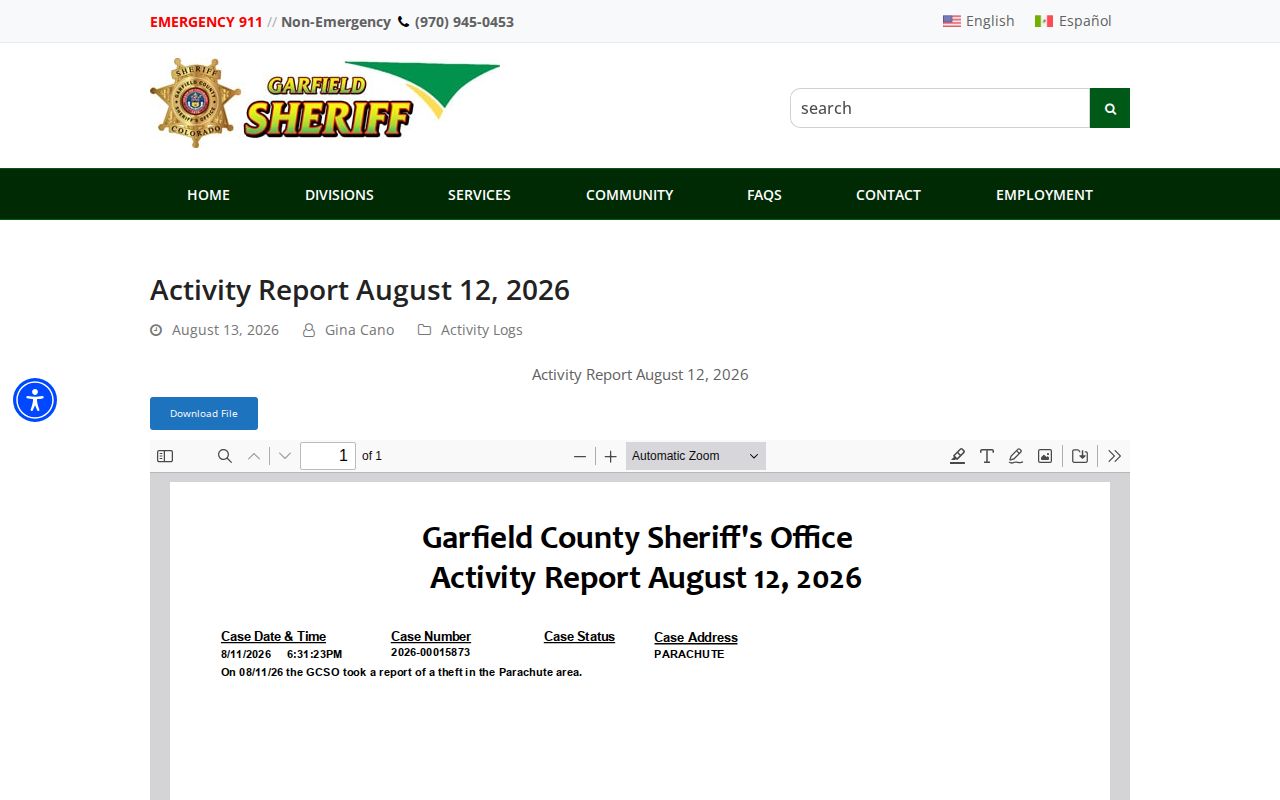
This is the official landing context for a single report, not a live custody roster.
Garfield Arrest Archives Beyond Online
The web archive reaches back months. But GCSO states no permanent online depth or retention period for activity reports. A page can vanish before the agency record itself expires. The reverse happens too. An office may hold a record that never appears in a public search.
Need a missing period? Contact the GCSO Records Division at 106 County Road 333A, Rifle, CO 81650. Reach records@garcosheriff.com, or call (970) 945-0453. Give the date or range, event location, involved name, and case number if known. The official request form plus an ID copy helps focus the search. Active investigations, sealed records, juvenile material, victim information, and prosecution discovery can all limit release.
Colorado's model sheriff retention schedule lists categories, not proof of what Garfield County adopted. It points to permanent jail commitment and discharge logs. Varied periods apply to inmate and patrol files, with legal-hold exceptions. Ask GCSO which local schedule applies. Older transferred material may need a Colorado State Archives finding-aid inquiry. Final case dispositions belong with Garfield Combined Court.
Garfield Arrest News Versus Logs
Newsrooms tell stories; jails keep lists. That gap matters here. The Post Independent crime section publishes daily online with print editions twice a week, covering Glenwood Springs and greater Garfield County through selected crime and court stories. It works as journalism, not a scheduled sheriff blotter. The Sopris Sun adds episodic crime reporting from Carbondale and the Roaring Fork valley. Neither outlet promises every arrest in the county. For that second layer of context on Garfield County arrests, the Post Independent crime source is the natural stop.
Private archives sit even further from the source. JailRosters.org posts dated Garfield pages and calls itself a private aggregation of public records. Arrests.org takes a different approach. Its Garfield section carries dates, pagination, images, and city labels, though some entries simply say charges unknown. Sites like these can go stale, misstate who is in custody, or miss bookings entirely. Official sources come first. No private photographs are rehosted here.
Note: News stories and private archives can outlast the online sheriff report, but neither proves current custody or guilt.
Garfield Arrests Require Court Review
An activity narrative preserves the agency's account at a single stage. Filed counts can change. Prosecutors may file different counts later. Dismissal, acquittal, a plea, or a sentence belongs to the court process, never to the activity archive. Use the Garfield County Ninth Judicial District docket for a short current window. Request older case documents from Garfield Combined Court. One caution remains. A release from jail does not erase the charge. It may follow bond, release on recognizance, a transfer, or another custody action. Match the sheriff case number against court details, since the two systems may not share an identifier.